Klunger er et annet ord for nyper eller kratt av ulike nyperosebusker eller lignende blomstrende busker med torner. Disse buskene vokser det mengder av nede ved sjøen akkurat i området nede ved Vågsvågen som kalles Klungvika; derav navnet. Og, mengder av busker gir mange nyper, og det igjen gir muligheter for hjemmelaget nypesyltetøy for den som orker å plukke nyper og pelle frø. Nypesyltetøy smaker nydelig godt, og jeg tar gjerne i mot en smak.
KlungvikaA small section of the rosehip bushes
Fun fact: The name of this part of the farm comes from a plant there is an abundance of right in this specific area. Down by the seashore it grows loads of bushes of rosehip. In Norwegian these bushes are called nyper or klunger; hence the name Klungvika. Plenty bushes give plenty berries for the ones who feel like picking them and ridding the berries of their seeds. The jam tastes delicious!
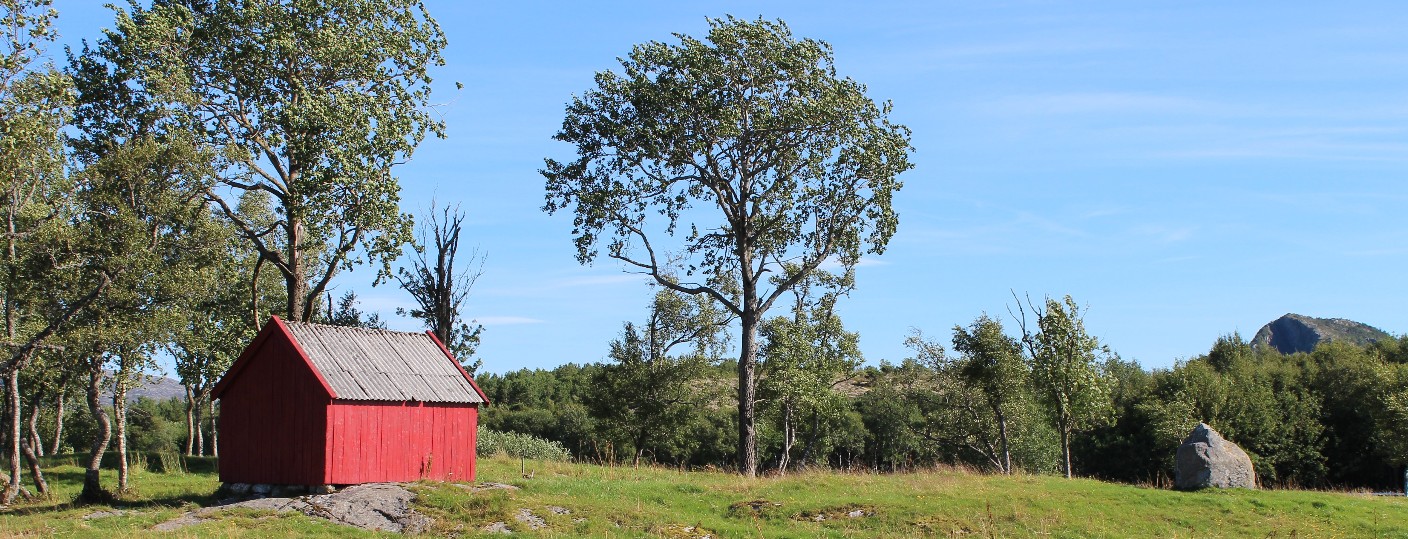
Ever wondered about the story of a rock? Maybe you have even wondered about the story of this spesific one? It is quite visible for everyone passing by on the road close to it.
Kalvhus-steinen (The Calf-house rock)
The Rock looks like something the ice left behind on top of the hill back in the Ice Age. Sure, the ice could have moved it there, theoretically. The moving ice could grind and move like nothing else.
Sorry to disappoint you though. The ice never brought it there; one human did. The rock surfaced in the beginning of the 1970s, when Willy was fixing up the nearby field. Most of it was deep down in the dirt, only the top making trouble for the farmer. It was just like an iceberg, with the top showing and the rest of it below the surface. With his old digging-machine, Willy worked the Rock to the location where it now rests, nice and heavily, probably never to be moved.
The farm has its name from the ocean bay close by called Vågsvågen.
Different spellings of the name through the ages have been Wage, Vog, Wog, Wogh, Waag, Wog, Vaag, Waag, Wåg and now the modern version is Våg. Different papers from different periods show the various spellings. The official documents states the name Vaag for this property, and hence the name we use in writing about the farm. The modern official address goes by the modern spelling Våg.
The history of the name is old, and there are traces of early, early agricultural activities and people living in this specific area, dating back to at least the Iron Age, it might even be from the Stone Age. The story tells that there have been found an axe of flint dating 3000 years back, among other things.
During 1982 and 1983 grandfather Asmund built this charming, little boathouse down by the shore of Vågsvågen, close to Klungvika. It was mainly his project, but both my father and a neighbor, Knut, helped him out a bit.
The materials used in the build was from the old barn up on the farm, which at this point was in the process of being torn down.
The boathouse has since it was built served as storage but also as our little retreat spot, and we try to use it year round.
These images are small glimpses of part of our garden as of August 1st, 2020, and it can sure look nice – with the angle of the camera just right!
A mix of late and early bloomers.The Peacock overlooking the pond with which we do not know what to do…This year’s expansionOvergrown, just a bit… hiding the old-style railing of the play-house made by Morten.
Flowers are nice, and I suppose most people agree that blooming flowers are nice, of course.
Easy-growing yellow nightmare flower.This lily used to be white with a red line. Moved it – and it turned out all pinkish.Yellow, cool lilies my mother left behind when she moved. I am not sorry for that. My favorite: Blue beauties!!!
My favorite flower color is definitely blue – and when it comes to flowers, blue flowers share a wide variety of shapes and shades, and most of them look awesome. My blue flower-area-project have been corrupted over the years, though. The blue does not stand by itself anymore, and is accompanied by white, green, yellow, pink and so on.
And, guess what, it looks fairly decent when the weeds are taken away!!!! Since I hate pulling weeds: Yes, I admit it!!!! I had the help of my adorable husband and my brother’s superdupergirlfriend! Thank you!
She is the one with the longest horns and is the oldest one out of the herd of Scottish Highland Cattle on our farm. She is the definite leader of the clan.
Iris of Trollhaugen, born 2012
We do mainly keep cattle of the breed Norwegian Red, but these Scottish cows are sooooo beautiful. Fall of 2017 our little heard of two Scottish cows and two heifers moved in. Since then the little herd has grown in size, now counting seven, and numbers still growing.
This nicely painted piece of wood was used as a road sign ages ago. It was placed at the road intersection right down by our farm telling people where they were, and where to go!
In addition to the name of the intersection itself, the additional parts of the sign tells where the road goes and the distance to these places.
Handmade, and with the exact same information on the other side.
The date of origin remains unknown, but the story tells that Marius Skogli, the last man to live in the little, now red, cottage close to the intersection, was the local road keeper back in the days. He kept the signs after they were taken down for new metal ones in the late 1960’s.
Marius maintained and kept the roads in old, old Nærøy county. Marius and wife Gurine built Mariusstua in 1933, and he lived there until he died in 1968. More of his story is in the local “Nærøy bygdebok IV”. His descendants, whom now was ready to part with this little keepsake, kept the signs for many, many years. I really do appreciate being able to display these cool, old signs!
A dairy farm needs cows. If there are no cows – no dairy farm!
Video is from when they first got out this spring. Always fun to watch the dairy-laidies when they discover the door is open!
This is only the beginning. Within 5 minutes, the barn was empty, and the whole bunch of milking-girls were outside! On days like this, one sure do wish the weather could be like this year round, so that all of the herd could be outside all the time. Truth is, we do live in a place where it could get really soggy and wet, and on those days, the cows are actually better off inside.